
1 August 2026
Tilt And Turn Windows In Exeter: Are They Worth It?
The first time most people come across tilt and turn windows is when a friend mentions them after moving into a new build, or when a window company quotes them as part of a larger replacement job. They’re common enough in Germany and across northern Europe that arriving in the UK via immigration and renovation is a normal path. Whether they’re actually worth the extra cost for a specific Exeter property is a different question.
How The Mechanism Works
The mechanism is simpler than it sounds. The window has a single handle with three positions. Handle pointing down: window locked closed. Handle horizontal: window tilts - the top opens inward at an angle of roughly 100-150mm while the bottom stays fixed. Handle pointing up: the window turns, swinging open on a side hinge like an inward-opening door.
The tilt and turn isn’t two separate mechanisms bolted together. It’s a single interconnected system where the handle position determines which way the opening hardware engages. Quality tilt and turn mechanisms from manufacturers like Roto, Siegenia, or GU are highly reliable - the moving parts are simple and well-engineered. Cheap mechanisms from obscure suppliers are less so, and a failed tilt and turn mechanism is more involved to replace than a failed casement stay.
The quality of the frame matters as much as the mechanism. A tilt and turn window places different loads on the frame than a standard casement - the sash is heavier because the mechanism is heavier, and the inward turn puts bending load on the hinge points. Better profiles handle this well; budget profiles can develop binding or sagging over time.
The Practical Case For Tilt And Turn In Exeter
Ventilation without security risk is the main practical argument. The tilt position opens the window enough for air circulation - fresh air in, warm air out - while leaving a gap that’s too narrow for a person to climb through and too high for a young child to fall out of. In Devon’s climate, where a bedroom window left slightly open overnight is the difference between sleeping comfortably and not, the tilt position is genuinely useful.
Standard casements handle this with restrictors - a stay that limits how far the window opens. Tilt and turn handles it mechanically, which is more reliable. A restrictor can be disengaged; a tilt mode window in tilt mode can’t be pushed further open from outside.
The cleaning advantage is real on upper-floor Exeter properties. Most of the Victorian and Edwardian terrace housing in Heavitree, St Thomas, and Pennsylvania has no side access. External window cleaning on the first or second floor either needs a window cleaner or a ladder. With tilt and turn, the outside glass is reachable from inside by opening in turn mode. For a homeowner who doesn’t want a regular window cleaner and doesn’t want to go up a ladder, that’s a tangible quality-of-life difference.
Emergency egress is worth mentioning. Building Regulations require at least one openable window in a habitable room. Tilt and turn windows in turn mode meet the egress requirement comfortably - the opening is larger than a standard casement when fully turned. In rooms where the window is the primary escape route, this matters.
Where Tilt And Turn Works Less Well
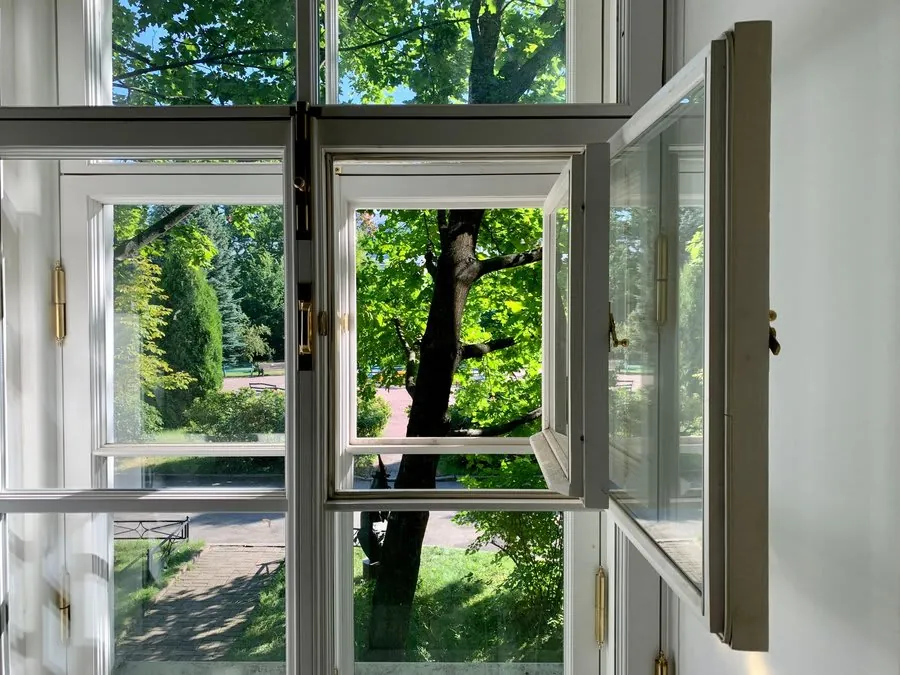
Inward-opening windows need clearance. In turn mode, the sash swings into the room. A standard-height window - 1050mm sash height - needs roughly that distance clear of the frame before it’ll open fully. Furniture, a deep windowsill, a radiator directly below, or a curtain track fixed close to the glass all potentially limit or obstruct the opening.
Victorian and Edwardian Exeter properties often have features that make this harder to manage. Original timber window seats, wide sills, deep reveals with plasterwork that runs close to the frame edge, and radiators positioned under windows (the standard convention for keeping external walls warm) are all common on those properties. It’s worth getting a physical measurement of the clearance before ordering, not just assuming it’ll work.
External appearance is different from a standard casement. Tilt and turn windows typically have a slightly different sight line pattern around the perimeter because the lock points are more complex. On most properties this is visually neutral. On a conservation area front elevation where the planning officer is looking at profile authenticity, it’s worth raising during the pre-application process.
They’re also not right for every room. A small bathroom window at 600mm wide is a reasonable tilt and turn candidate. A very wide picture window with two or three sashes is better specified with the main sash as a tilt and turn and the remaining sections as fixed lights, not as three tilt and turn units across the full width.
Tilt And Turn In uPVC Vs Aluminium
Tilt and turn is available in both uPVC and aluminium, and the choice between them follows the same logic as for standard casement windows.
uPVC tilt and turn gives you the mechanism at a reasonable price. Standard sizes in mid-range uPVC profiles can be quoted at £400-£700 fitted per window. The profiles are necessarily wider than aluminium - the frame sections are bulkier to handle the structural loads - which means slightly less glass for a given opening. On a bedroom window where you mainly want the tilt ventilation and occasional full-width cleaning access, that trade-off is fine.
Aluminium tilt and turn makes sense where the slim profile matters. On an extension or a larger aperture where every millimetre of frame is a millimetre less glass, the difference between a 70mm uPVC frame face and a 45mm aluminium frame face is meaningful. Aluminium is also more rigid under the bending loads the tilt and turn mechanism creates, particularly on larger sashes. A 1200mm-wide tilt and turn in aluminium will operate more smoothly over time than the same window in uPVC.
The cost premium for aluminium tilt and turn over uPVC is typically £200-£350 per window. On a full house, that’s a significant addition. On two or three specific windows where the performance difference justifies it, it’s much easier to absorb.
What Tilt And Turn Windows Cost In Exeter
In uPVC, a standard tilt and turn window (900mm x 1050mm, A-rated double glazing, standard white or foiled colour) runs £450-£750 fitted in Exeter. That’s £100-£200 more than a standard casement of the same spec. Larger sizes, unusual colours, or triple glazing add to the cost in the same proportion as any other window type.
In aluminium with a thermally broken profile, the same size runs £750-£1,100 fitted. The mechanism premium over a standard aluminium casement is the same as in uPVC - roughly £100-£200 per window.
On a full house replacement where every window is specified as tilt and turn, the premium over all-casement is typically £800-£2,000 on the project. Some customers specify tilt and turn selectively: first-floor bedrooms and any window without external cleaning access get tilt and turn; ground-floor rooms with easy external access get standard casements. That’s often the most cost-effective approach.
Lead times for tilt and turn windows are the same as for standard windows from the same manufacturer - typically three to six weeks for uPVC, four to eight weeks for aluminium. The mechanism doesn’t require bespoke manufacturing; it’s a standard component fitted during production.
Is Tilt And Turn Right For Your Exeter Property?
It depends more on the room than on the property type. Tilt and turn windows work on any Exeter property - Victorian terrace, 1930s semi, modern build - as long as there’s adequate internal clearance for the turn mode. Two questions settle it: how much space is there between the window frame and the first piece of furniture, sill, or fitting in the room? And is the external cleaning access enough of a problem that the turn mode would genuinely get used?
For a south or west-facing Exeter bedroom where overnight ventilation is a real consideration - and where the tilt position means you can sleep with the window open without weather or security concerns - tilt and turn is straightforwardly worth the premium. For a ground-floor kitchen window with direct garden access and no upper-floor access issues, a standard casement costs less and does the same job.
Our window installation team fits tilt and turn windows across Exeter in both uPVC and aluminium. If you’re weighing up whether tilt and turn is the right specification for your property, the site visit is where that question gets a real answer - we can look at the clearances, the access, and the specific rooms before any decision is made. Get in touch to arrange a visit.
Frequently Asked Questions
What is a tilt and turn window?
A tilt and turn window has two opening positions controlled by a single handle. In the tilt position, the top of the window opens inward at an angle - typically 100-150mm - while the bottom stays fixed. This gives ventilation without a fully open window: no rain gets in, no child or pet can fall out, and no one can climb in from outside. In the turn position, the whole sash swings inward on a side hinge, opening fully like an inward-opening casement. One handle, rotated to different positions, controls which mode the window is in. The mechanism is common across Germany, Austria, and the Netherlands and is increasingly specified on UK new builds and replacement windows.
How much do tilt and turn windows cost in Exeter?
Tilt and turn windows cost roughly £100-£200 more per window than a standard casement of the same size and specification. For a standard size (900mm x 1050mm) in uPVC, expect to pay £450-£750 fitted including standard double glazing. In aluminium, the same window is typically £750-£1,100 fitted. On a full house replacement, specifying tilt and turn throughout adds around £800-£2,000 to the project cost compared with standard casements. Some homeowners specify tilt and turn on specific rooms - upper-floor bedrooms, rooms with no side access for external cleaning - and standard casements elsewhere.
Are tilt and turn windows harder to clean than standard casement windows?
No - they're easier. The full turn opening means you can reach the entire outside glass area from inside the room. On standard outward-opening casements, cleaning the outside of an upper-floor window means either using a long-handled tool, a window cleaner with a ladder, or an access platform. A tilt and turn window opened in turn mode lets you clean the outside face of the glass by leaning out through the fully opened sash - or, on many windows, by swinging the sash all the way back so the outside face is now facing into the room. For upper-floor Exeter properties without side access or external scaffold points, this is a practical advantage.
Do tilt and turn windows suit older Exeter properties?
They suit any property where the opening configuration is compatible. The inward opening in turn mode needs clearance inside - a radiator, furniture, or windowsill that runs close to the frame will restrict how far the window can swing. In a Victorian or Edwardian Exeter terrace with deep reveals and deep internal sills, this is worth checking before ordering. Externally, tilt and turn windows look similar to a standard casement - the visible difference is the handle style and, on some profiles, slightly heavier sight lines around the lock points. They don't look out of place on period properties in the way that some people assume.