
2 October 2026
Replacing Windows In Exmouth And Budleigh Salterton: Salt Air, Seafront Terraces And East Devon District Council

Exmouth is eleven miles down the A376 from Exeter and it feels like a different county once you get there. The 2021 census counted 35,488 people in the town, which makes it the biggest in East Devon, and a good share of them live within a few hundred metres of open water, either the sea along the Esplanade or the Exe estuary at the back of the docks. Budleigh Salterton, four miles further along the coast road, is smaller at 5,240 and older: the same census put around 45% of its residents at 65 or over, the highest proportion of any town in England. Both sit under East Devon District Council, not Exeter City Council, and both have the Jurassic Coast World Heritage Site on their doorstep, which begins at Orcombe Point at the eastern end of Exmouth beach. For anyone replacing windows, those facts translate into salt, wind, conservation rules and a council that is not the one most Exeter firms are used to dealing with.
Why Exmouth And Budleigh Windows Age Differently To Exeter Ones
Drive in from Exeter and the change in exposure starts before the town does. The A376 runs along the eastern shore of the Exe, and the estuary funnels the prevailing south-westerlies straight up its length. From Lympstone onwards, anything with a west-facing elevation gets wind off the water for most of the year. Round the corner at the seafront the sea itself takes over, and the open ground of the Maer behind the beach gives spray a clear run into the streets behind it. Budleigh is more sheltered from the west by the headland, but its front faces squarely south across Lyme Bay and takes whatever a southerly storm brings in.
Salt is the ingredient Exeter homes never meet. Spray dries on glass, frames and hardware and leaves crystals that pull moisture out of the air and hold it there, so a seafront window never fully dries between showers. Grit from the beach does the rest, working into runners and seals. The pattern we see on surveys for window installation in Exmouth is consistent: misted sealed units, handles that have gone stiff, friction stays with brown weeping from the rivets, and on timber, paint failing on the bottom rail long before it fails anywhere else. Based on the Exmouth and Budleigh jobs we have quoted, those problems show up on properties within a mile of the sea at roughly twice the rate we see across Exeter, and the windows are often five years younger when they do.
The housing stock makes the picture more varied than it first looks. Exmouth runs from Georgian and Regency villas on The Beacon and Louisa Terrace, through the tall Victorian terraces along the Esplanade, out to the big interwar and postwar estates at Withycombe Raleigh, Littleham and Brixington, and on to the 2010s housing on the Littleham side. Budleigh has its cottages built from the beach’s own rounded pebbles, Victorian villas climbing the hill from the front, and a lot of single-storey retirement homes with large, simple windows that face the weather with nothing in front of them.
What Salt Air Does To Hardware, And What To Specify Instead

The first thing to fail on a coastal window is almost never the frame. It is the metal that moves: the friction stays that carry a casement, the espagnolette gearing inside the sash, and the handle you touch every day. On a standard inland window those parts are zinc-plated mild steel with a passivated finish, or die-cast zinc alloy with a lacquer over the top. That coating is a few microns thick. Salt attacks it from the day the window goes in, and once it is through, the steel underneath rusts, the stay stiffens, and eventually the rivet lets go. We have seen stays on seafront flats in Exmouth seize inside four years. That is not a faulty stay. It is the wrong stay.
The fix is to ask a question most installers never get asked: what corrosion grade is the hardware? BS EN 1670 grades building hardware from 1 to 5 by how long it survives a neutral salt-spray test, and only grade 4 and grade 5 belong anywhere near the Esplanade or Marine Parade. Several manufacturers make stays in austenitic stainless steel specifically for coastal and marine positions, and the cost difference per window is small against the price of the whole job. Handles should be stainless or a properly sealed finish rather than bright chrome plating, which pits quickly in salt.
Ask for all of it in writing on the quote. “Heavy duty” on a brochure means nothing you can check.
Glazing units have their own vulnerability. The edge seal that keeps the argon in and the moisture out is a polymer, and salt-laden damp sitting in the glazing rebate attacks it over years. A frame with clear drainage slots that are actually open, a warm-edge spacer bar and a dual-seal unit buys time. So does telling the fabricator the window is going into a coastal position, because the better ones will adjust the specification without being asked twice.
uPVC, Aluminium Or Timber On A Seafront Elevation

uPVC does not corrode, which is why it has sold so well along this coast since the 1980s. The catch is the steel reinforcing bar inside the frame. If water gets into the chamber through a blocked drainage slot or a failed weld, the galvanised steel inside can rust and the frame starts to bow or crack at the corners. It is rare on a well-made window, but it is why we check drainage on every seafront job. White uPVC also suffers more visibly from salt and sand than it does inland: the surface picks up a grey film that needs washing off, and the outer face of a south-facing frame on the Esplanade will chalk sooner than the same frame in Heavitree. Foiled colours are more forgiving.
Aluminium is the material most people assume is bulletproof by the sea. It is, if the finish is right. Bare aluminium forms a protective oxide, but chlorides break it down and you get filiform corrosion creeping under the powder coat from any scratch or cut edge. The answer is a marine-grade pre-treatment and a thicker coating applied to a seaside specification, which reputable powder coaters offer as a named upgrade. If an aluminium quote for a house on Foxholes Hill or Cliff Road does not mention the coating specification, ask. Our longer comparison of uPVC against aluminium for Exeter homes covers the general case, but at the coast the finish decides it rather than the metal.
Timber has the oldest claim on these streets and the worst reputation, largely because of what salt does to paint. Crystals sitting on a bottom rail hold moisture against the coating until it lifts, and once water is under the paint the rail swells and the joints open. Modern factory-finished timber with an engineered, laminated section, a microporous coating and proper end-grain sealing is a different product from the softwood casements of forty years ago, but it still needs recoating every few years on an exposed face. For a listed villa on The Beacon or a cottage in the Budleigh conservation area it may be the only material the council will accept, and in that case maintenance is part of ownership rather than a flaw in the window.
Wind Loading And Glass On The Exposed Elevations

Wind pressure on a window rises with exposure, and the Exmouth seafront and the cliff-top streets above Budleigh count as about as exposed as a residential site in Devon gets. A large fixed pane on a south-facing bay takes a load in a winter gale that an identical pane in a sheltered Exeter cul-de-sac never sees. Window systems are rated for this, with weather performance tested to BS 6375 for air leakage, water tightness and wind resistance, and the rating is something you can ask for. A fabricator who knows the window is going on the Esplanade will size the reinforcement and the glass accordingly rather than supplying the stock specification.
Glass thickness is the most common upgrade. A big seafront picture window or a wide bay pane may move from the standard 4mm leaves to 6mm, or to toughened glass, to stop the pane flexing enough to stress the edge seal or, in the worst case, to break. That flexing is also why sealed units on exposed elevations mist sooner: every gust pumps the pane in and out and works the seal. Heavier glass costs more and weighs more, which is another reason the hinges and stays on a coastal window should not be the lightweight items.
The other thing wind does is drive rain horizontally. A window fitted perfectly square but sealed with a single bead of silicone to a rendered reveal will leak on the Esplanade where it would not in Alphington. Weather bars, properly compressed gaskets, a continuous seal behind the external trim and drainage designed to cope with water being pushed back up the frame all matter more here. On an older seafront terrace the brickwork itself is often soft with salt, and the reveal needs making good before the new frame goes in rather than afterwards.
Planning And Conservation Areas Under East Devon District Council
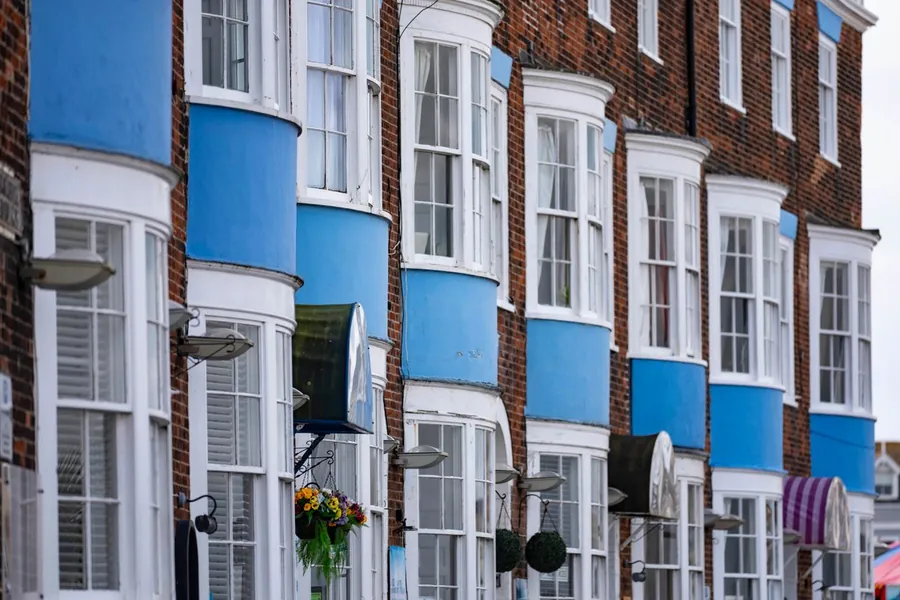
The first thing to get right is which council you are dealing with. Exmouth and Budleigh Salterton are both in the East Devon district, so East Devon District Council handles planning and building control for them, and Exeter City Council has no role. EDDC looks after more than thirty conservation areas across the district. Exmouth’s takes in The Beacon, Louisa Terrace, Bicton Street and Albion Street, which is where the town’s Georgian and early Victorian stock is concentrated. Budleigh’s covers the town centre, part of Marine Parade and the ground between the High Street and the sea, plus East and West Terraces, Westbourne Terrace, The Lawn, Chapel Street and Little Knowle. Budleigh also has 37 listed buildings, which is a lot for a town of 5,000 people.
For a house outside those areas, replacing windows is permitted development and nobody at EDDC needs to be told. The Planning Portal’s guidance on doors and windows sets out the basic position, and it applies to a semi in Brixington exactly as it does to one in Pinhoe. Inside a conservation area the rights still exist, but the appearance of the new window becomes a planning matter. Replacing a timber sliding sash on Louisa Terrace with a uPVC casement that opens differently, has thicker frames and loses the glazing bars changes the character of the elevation, and EDDC can treat that as development needing permission. The practical route is a like-for-like replacement: a sash that slides, sightlines close to the original, glazing bars where there were glazing bars, and a finish the conservation officer will accept. Slimline timber or well-detailed uPVC sash windows can both get through, but the drawings need to go in first rather than the window.
Article 4 directions are the point to be careful on. A direction removes permitted development rights for specific works in a specific area, and some councils use them in conservation areas precisely to control windows. We are not aware of one covering windows in either Exmouth or Budleigh at the time of writing, but we check with EDDC’s conservation team before quoting any job inside the boundaries, because the answer can change and the cost of getting it wrong is an enforcement notice and a window that comes out again. Flats and listed buildings are different again: flats have no permitted development rights for external alterations, and a listed villa on The Beacon needs listed building consent for any change to its windows, which is a separate application with its own timescale. Our post on windows in listed buildings around Exeter covers what that involves.
Building Control And FENSA Sign-Off In East Devon

Planning and building control are two different departments with two different jobs, and a window can be fine with one and not the other. Replacement windows have counted as controlled work under the Building Regulations since 2002, which means every new window has to meet the thermal, ventilation, safety glazing and fire escape requirements, and somebody has to certify that it does. There are two routes. An installer registered with a competent person scheme self-certifies the job and the scheme notifies the council. Or the homeowner, or the installer, makes a building regulations application to EDDC’s building control team, pays the fee, and an inspector comes out.
FENSA is the largest of the schemes and the one most people have heard of. When we finish a job in Exmouth or Budleigh, the installation is registered and the certificate is posted to the homeowner within a few weeks, and it is lodged with the local authority at the same time. That piece of paper is what a conveyancing solicitor asks for when you sell. Without it, a buyer’s solicitor will usually insist on an indemnity policy or a regularisation application to EDDC, which involves an inspector looking at work that is already finished and may mean opening things up. In Budleigh, where a good proportion of homes change hands as owners move into care or downsize, that certificate turns up as a question on a surprising number of sales.
The parts of the regulations that bite hardest at the coast are the ones about ventilation and safety glass. Sealed modern windows in a house that used to leak air through its old frames need background ventilation designed in, usually trickle vents, and on a damp seafront property that is not a box-ticking exercise. Any glazing within 800mm of the floor, in or beside a door, or in a bay a child could fall against, has to be toughened or laminated. First-floor bedrooms need an opening big enough to escape through. None of it is unique to Exmouth, but the inspector who checks it, if an inspector is involved, works for East Devon.
What Coastal Spec Does To The Price In Exmouth And Budleigh
Our guide figures for a standard white uPVC casement fitted in Exeter run from roughly £450 to £800 per window depending on size and style, and a whole house of eight to ten windows usually lands between £4,000 and £8,500. The window going into a house in Littleham or on the Budleigh retirement estates costs the same to make as one going into Pinhoe. What changes is what a sensible installer adds to it. Based on the jobs we quote along this stretch of coast, upgrading to stainless or high-grade stays and handles, specifying a marine-grade finish on aluminium, and moving to thicker or toughened glass on the big exposed panes adds somewhere between a tenth and a fifth to the per-window price for properties within a mile or so of the sea. On a sheltered estate house in Brixington or Withycombe Raleigh the uplift is close to nothing, because the exposure does not justify it.
Conservation-area work is a separate line. Timber or timber-look sash windows made to match a Georgian frontage on The Beacon or a villa on Westbourne Terrace cost a multiple of a standard casement, and the planning drawings and application add time rather than much money. It is worth knowing before you fall in love with a quote that the cheapest window is often the one the council will not let you fit.
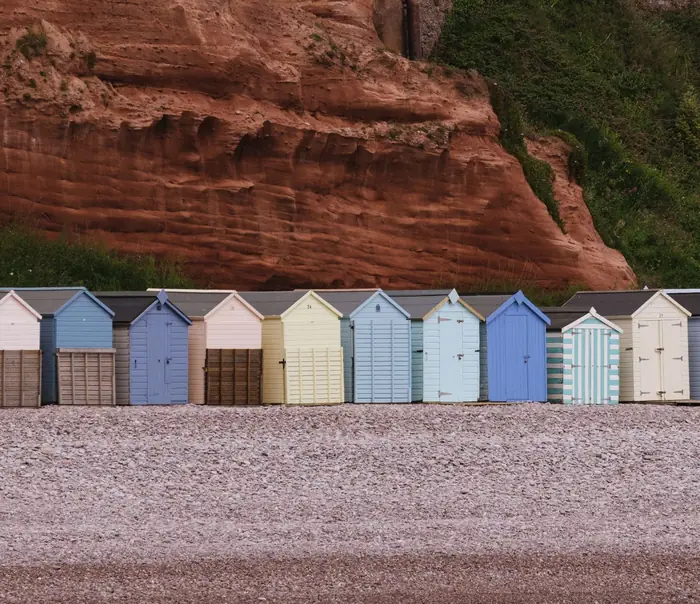
Two things we do not add. There is no travel charge to Exmouth or Budleigh from our base on Topsham Road; the A376 is a thirty-minute run and we are on it most weeks. And we do not price a coastal specification into a job that does not need it. The red cliffs that give Budleigh its beach and start the Jurassic Coast World Heritage Site at Orcombe Point are a reminder that exposure here is real, but a bungalow half a mile inland behind the town is not on the seafront and should not be quoted as if it were.
How We Cover Exmouth And Budleigh From Exeter

The process is the same as it is in the city: a free survey, measured drawings, a written quote that lists the hardware grade and the glass specification rather than hiding them in a brochure code, then fitting from Exeter with the same team that does the city. The survey is where the coastal questions get answered. We look at which way the elevation faces, how far it is from open water, what has already failed on the existing windows and why, whether the property is inside a conservation area boundary, and whether anything about the brickwork or render needs attention before a new frame goes in.
For the estates, that usually means straightforward uPVC with upgraded hardware and a check on drainage. For the seafront terraces it means a conversation about glass thickness, gaskets and whether the bay needs structural attention before anything else. For The Beacon, Louisa Terrace and the Budleigh conservation area it means drawings for EDDC before an order is placed. If you have been told your old windows should have lasted twenty years and they have given up at twelve, our post on how long double glazing actually lasts near the coast explains why that is normal rather than a defect, and what to specify so the next set does better.
Book a free window survey in Exmouth or Budleigh Salterton and we will tell you what the position of your house really needs, and what it does not.
Frequently Asked Questions
Is Exmouth under Exeter City Council or East Devon District Council for window replacement?
East Devon District Council. Exmouth and Budleigh Salterton both sit inside the East Devon district, so EDDC is the planning authority and the building control body for both towns, even though Exeter is only eleven miles up the A376. Exeter City Council has no say over either town. That matters for two reasons. If your house is in one of the two conservation areas, EDDC's conservation officers are the people who decide whether a change to your windows is acceptable. And if your installer is not registered with a competent person scheme such as FENSA, the building regulations application for the replacement goes to EDDC's building control team and the fee is paid to them, not to Exeter.
Do I need planning permission to replace windows in the Exmouth or Budleigh Salterton conservation areas?
Usually not for a straight swap, but the margin for change is narrow. Replacing windows is normally permitted development for a house, and being in a conservation area does not remove that on its own. What a conservation area does is make the appearance of the new window a planning matter. Swapping a timber sliding sash on The Beacon or Westbourne Terrace for a uPVC casement with a different opening pattern, thicker frames and no glazing bars changes the look of the elevation, and EDDC can treat that as development needing permission. Flats, listed buildings and any property covered by an Article 4 direction lose the automatic rights entirely. We are not aware of an Article 4 direction removing window rights in either town at the time of writing, but we confirm it with EDDC before quoting any conservation-area job, because the position can change.
Why do window handles and hinges seize up faster in Exmouth than in Exeter?
Salt. Spray off the sea and the estuary carries salt crystals onto every outside surface, and those crystals pull moisture out of the air and hold it against the metal. Standard zinc-plated steel friction stays and die-cast handles with a thin lacquer rely on a coating that salt breaks down within a few years, after which the steel underneath pits and the stay stiffens or snaps. On an Exmouth seafront terrace or a Budleigh bungalow on the cliff road, hardware specified to a high corrosion grade under BS EN 1670, or made from austenitic stainless steel, is the difference between a window that still opens cleanly after fifteen years and one that needs new stays after five.
Does replacing windows in Exmouth or Budleigh Salterton cost more than the same job in Exeter?
A little, and it should. The window itself costs the same whichever town it goes into. What adds to the bill is the specification a coastal position justifies: stainless or high-grade friction stays and handles, a marine-grade pre-treatment and powder coat on aluminium frames, thicker or toughened glass on big seafront panes, and sometimes a higher weather rating on the whole unit. Based on the jobs we quote, that typically adds between a tenth and a fifth to the per-window price on properties within a mile or so of the sea, and almost nothing on a sheltered estate house in Brixington or Withycombe. We do not charge travel from Exeter to either town.